
Visual Schedule Maker
Make a picture schedule your child can follow. Pick a routine, choose your child and print it free.
Making a schedule for a teen or adult? Use the Visual Schedule Maker for Teens and Adults →
Free companion guide: The ABCs of Autism — plain-language basics for families, instant digital access →
Not sure where to start? Ask us →
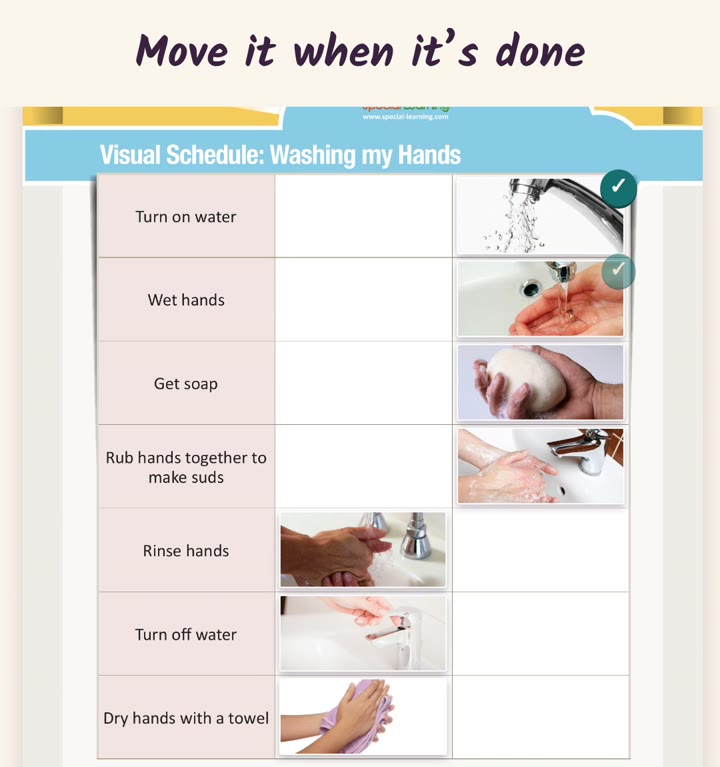
Choose a routineA picture plan for washing hands
Print the sheet or cut out its four pictures. To make a schedule with your own steps, choose a routine below.
Choose a Routine
Choose from five routines or start blank. Every routine step shows a child doing it. Pick the child who looks most like yours, and change any picture or word.

Morning Routine
Wake up, get dressed, breakfast, out the door

Bathroom Routine
Toilet, flush, wash hands, dry hands

Bedtime Routine
Bath, pajamas, brush teeth, story, sleep

School Day
Arrive, morning work, centers, lunch, recess

Mealtime
Wash hands, sit down, eat, clean up
Start from Scratch
Build your own schedule from a blank template
Your next step, in plain language
Tell us who you are and the Visual Schedule Maker opens right below. It’s free, and it stays free.
Sorting out the bigger picture for your family? What ABA therapy costs, and how insurance covers it · Estimate your ABA cost by state · The 15 questions to ask an ABA provider
Edit Your Schedule
Tap a step’s words to change them, or tap its picture to choose another. Move steps up or down, remove them, or add your own. Your schedule saves on this device.
Choose your child
To save a PDF, tap Print and choose “Save as PDF.” Pictures drawn by Special Learning.
More to print for the rest of the day: 16 free one-page cards, for teaching at home, school meetings, brothers and sisters, and you. Each goes with a free AutismFLIX video. En español: tarjetas para imprimir.
Visual schedules: each step of a routine, in pictures
A short walk-through with captions showing how a picture schedule presents each step of a routine.
Picture schedules are one kind of visual support, which the University of North Carolina's AFIRM project lists as an evidence-based practice for autistic learners. Source: AFIRM, Visual Supports.
More short how-tos for home, in order: Visual schedules and token boards at home (7 videos with captions, on YouTube).
Make the next step easy to see
Pick one routine. Add, reorder or remove steps, then print the schedule you made. Every routine step shows a child doing it, and you can pick from five children. Tap a picture to choose another from 67, or tap the words to change them. A step you add gets a matching picture when there is one, or a blank box to draw in.
The printout fits on one page, with pictures big enough to see from across the room. You can also print a strip or cut-apart cards, or save it as a picture for a phone or tablet.
For parents: the methods behind the schedule
Journey to Independence: ABA for Parents has 27 short video lessons for parents and caregivers: why behavior happens, how to teach a new skill step by step, and how to track progress at home. Try it free for 7 days.
The listed base price is US$129 for 12 months of access, lower in some countries. Previous trials of included material may affect eligibility. See course details.
Start the free 7-day trialKeep the home guide beside your schedule
Our free home guide walks through choosing one routine, breaking it into steps and making a picture for each step.
Read the free visual-schedule guidePlease knock
I'm ready to return
Hanukkah, one night at a time
Find a picture-schedule example to adapt to your family and a free quiet-break sign and card.
Read the free Hanukkah guideJust got a diagnosis? A free 4-week home plan: https://special-learning.com/autism/first-30-days-at-home/
Using "first, then" on the schedule? Our guide to the Premack principle shows how to put a less-preferred step before one the child already wants to do.
Frequently Asked Questions
A visual schedule is a series of pictures or symbols that represent activities in the order they will occur. They help children with autism understand what comes next, reduce anxiety about transitions, and build independence with daily routines.
Place the schedule where your child can see it. Before starting a routine, review the steps together. As each step is completed, your child can check it off or move to the next image. Use the same schedule each time you do that routine, so the steps become familiar to your child.
No. Visual schedules benefit any child who struggles with transitions, routines, or executive function. They are used in classrooms, therapy settings, and group homes for individuals of all ages.
No. The visual schedule maker is free, and there's no account to make. Pick a template first. A short form then opens before the schedule maker: your role, first and last name, email and country, and your ZIP code if you are in the US. Then change the steps and print.