
For heads of inclusion, SENCOs and principals of private and international schools in Dubai, Abu Dhabi and Sharjah
Training learning support assistants: what KHDA and ADEK ask of the role, what an LSA practises, and a way to start this term
KHDA’s guide for Dubai schools says: “In Dubai, the LSA replaces the former ‘shadow teacher’. LSAs should have access to ongoing professional development to ensure that they are fully effective in their roles.” In Abu Dhabi, ADEK’s Inclusion Policy names inclusion assistants, who “work under the direction of a teacher”, and individual assistants, “Formerly known as ‘Shadow Teachers’”. Special Learning’s Intro to ABA: Level 1 trains LSAs, inclusion assistants and teachers online: nine recorded sessions on the methods of applied behaviour analysis (ABA), then a final exam, watched on a phone or a computer in each person’s own time. A person buying from the UAE pays $199, in US dollars. A school training 10 or more asks us for a quote. Anyone can try the first two sessions free for 7 days, with no payment card.
Start the 7-day free trial
KHDA’s own words, read November 15, 2026
01Dubai: what KHDA’s framework asks of schools
KHDA’s Dubai Inclusive Education Policy Framework (2017) sets out standards for inclusive education in Dubai. On March 11, 2026, KHDA’s Director General issued Administrative Resolution No. (15) of 2026, which approves the Framework and the Directives and Guidelines for Inclusive Education for Private Schools “as published on the official website of the KHDA”. In its Article (2), they “apply to all educational institutions and Centres authorised to conduct Educational Activities” under the Executive Council Resolutions that regulate Dubai’s private schools and early childhood centres.
The Framework opens with the UAE’s own term: “Persons with determination. This is how the UAE has chosen to view the attributes of persons with disabilities; a reflection of their strength of character, their perseverance and their courage.” Standard 4 is addressed to all education providers. In the Framework’s own words:
| Standard | The Framework’s words | For a head of inclusion |
|---|---|---|
| Standard 4.11 | Ensure that “‘shadow teachers’ will be renamed ‘learning support assistants’. They will be accountable to the revised job description and will be required to complete the relevant training and development programme appropriate to their role within a time bound period.” | Each LSA has a training programme matched to the role, with a time frame. |
| Standard 4.12 | When learning support assistants “are employed by the parents of students who experience SEND”, the school implements a memorandum of understanding that includes “information about professional induction, monitoring and training requirements”. | Parent-employed LSAs have training requirements too, written into the school’s MOU. |
| Standard 4.13 | Learning support assistants will be required to “contribute to the education of students in inclusive schools and classrooms by implementing small-group and individual instruction”, and to “collect formative assessment data on student performance and progress, based on systems designed by teachers or Inclusion Support Team”. | Teaching in small groups and one to one, and keeping simple records of progress. |
Sources: Knowledge and Human Development Authority, Dubai Inclusive Education Policy Framework, 2017, foreword and Standard 4; Administrative Resolution No. (15) of 2026, issued in Dubai on March 11, 2026, Articles (1) and (2) (Dubai Legislation Portal, English version).

KHDA’s guide for schools
02The LSA role in KHDA’s words
KHDA’s Implementing Inclusive Education: A Guide for Schools (2019) describes the LSA as “a trained member of education support staff who works under the direction of a classroom teacher.” In its own words:
- Working with the teacher: “The classroom teacher is responsible, and ultimately accountable for, the impact and outcomes of the students’ educational programme.” LSAs are involved “in assessment processes, record keeping, lesson-planning, and resource development.”
- Training: “LSAs should be trained in using different approaches to lower barriers to learning, and to facilitate student engagement and participation within relevant and meaningful learning opportunities.”
- Independence: “An effective LSA provides a ‘bridge’ of support to students, helping them achieve what they are capable of without creating dependency. The development of independence in all aspects of school life is a key part of the role, and includes allowing a student to make mistakes and to look for their own ways to solve problems.”
- Measuring success: “key indicators of learning support success include; the extent to which students become more independent in their learning, are more able to regulate their emotions and behaviour, or are more tolerant and resilient in the face of challenge.”
- Staffing: the guide lists “meeting the expected ratio of LSAs across the school; equivalent to at least one LSA for every 125 students in the general student population”, and “providing sustained professional development opportunities to allow educators to strengthen the skills and specialist knowledge needed to work with all students in common learning environments.”
Source: Knowledge and Human Development Authority, Implementing Inclusive Education: A Guide for Schools, 2019, the sections on the role of the learning support assistant and on resourcing, and the glossary.
ADEK’s own words, with versions
03Abu Dhabi: who ADEK’s Inclusion Policy names
ADEK’s School Policy on Inclusion (Version 1.3, December 2025; compliance from the 2025/26 academic year) promotes “a rights-based approach to education for all students”, as set out in Federal Law No. (29) of 2006 Concerning the Rights of Persons with Disabilities and its amendments. It defines inclusive education as “An approach to education which celebrates and acknowledges learning diversity and ensures that teaching is adapted to enable all students to learn.” Its Inclusion Team is “Led by the Head of Inclusion” and includes Inclusion Teachers, Inclusion Assistants and Individual Assistants. The staff it names, in its own words:
| Role | ADEK’s words |
|---|---|
| Head of Inclusion (4.1.1) | Schools “shall appoint at least 1 Head of Inclusion”. Heads of Inclusion who need CPD as their additional qualification complete, within one year of appointment, “60 hours of coursework through local and/or international training providers” on topics such as “Strategies to support SEND”. |
| Inclusion Teacher (4.1.2) | “at least 1 Inclusion Teacher per cycle”; those who need CPD as their additional qualification complete “40 hours of coursework” within one year of appointment. |
| Inclusion Assistant (4.1.3) | Schools “shall appoint Inclusion Assistants to provide additional support to teachers for students with additional learning needs”. They “work under the direction of a teacher” and may give whole-class support, small-group support, or “Dedicated 1:1 support to a particular student, if required”. |
| Individual Assistant (definitions, 4.1.4, 4.3.2) | “Formerly known as ‘Shadow Teachers’, Individual Assistants are parent-funded staff who provide 1:1 support for students with additional learning needs”. Under 4.1.4 they give “personal care and other non-teaching related support”, are “available outside the classroom” and enter it “only upon request by the teacher”. The school provides “guidance for Inclusion Assistants and any interested Individual Assistants in their professional development.” |
| Staff Eligibility Policy, Inclusion Assistant | One of three eligibility profiles: a QFE 4 certificate plus “20 hours of in-house or external training within the first year of employment”. |
ADEK’s Staff Eligibility Policy also gives the Head of Inclusion’s other names: “Special Education Needs Coordinator (SENCo), PoD/SoD/SEND Coordinator, etc.”, and the Individual Assistant’s: “Shadow Teacher, Individual PoD Support Assistant.”
Sources: ADEK School Inclusion Policy, Version 1.3, December 2025, introduction, definitions, section 4.1 and section 4.3.2(e); ADEK School Staff Eligibility Policy, Version 1.3, September 2024, Tables 2 and 3.
Professional development
04What ADEK says about CPD hours
Two ADEK policies set the hours of continuous professional development (CPD) a school provides. In ADEK’s words:
- All staff: “Schools shall ensure that all staff complete 25 hours of CPD annually, including any ADEK-mandated training, at no cost to the staff” (ADEK School Employment Policy, 3.12).
- Teachers: “Schools shall ensure that teachers complete a minimum of 75 hours of planned CPD per year at no cost to staff.” The school’s CPD plan includes “Details on the provision of CPD via in-house or third-party providers.” (ADEK School Quality Assurance Policy, 1.4)
- Inclusive education for every teacher: “all teachers shall participate in CPD on inclusive education”, including “Adaptive teaching strategies for diverse learners” and “Collaborating with Inclusion Teams to develop and implement Documented Learning Plans (DLPs).” (ADEK School Inclusion Policy, 4.1.5)
- What CPD is, in ADEK’s definition: “CPD includes in-person training, online training (synchronous or asynchronous), coursework, short certificate and degree programs, mentorship programs, peer/collaborative learning, academic conferences, research projects, observational visits, and community programs to share teaching best practices. CPD excludes planning hours and general staff meetings.” (ADEK School Staff Eligibility Policy, definitions)
Sources: ADEK School Employment Policy, Version 1.1, September 2024, 3.12; ADEK School Quality Assurance Policy, Version 1.1, September 2024, 1.4; ADEK School Inclusion Policy, Version 1.3, December 2025, 4.1.5; ADEK School Staff Eligibility Policy, Version 1.3, September 2024, definitions.
LSAs in the classroom
05What an LSA practises, and a 12-week plan
A learning support assistant helps one student or a small group take part in an inclusive class, under the direction of the class teacher. Dubai uses the title LSA, where shadow teacher was the old name. ADEK distinguishes inclusion assistants, who support teachers, from parent-funded individual assistants, who give a student personal care and other non-teaching support. Our page on shadow teacher training sets out the role in more detail, and our page on autism training for paraprofessionals describes the same work in US schools.
Day to day, an LSA working with an autistic student helps them follow the lesson the class teacher planned, breaks a task into smaller steps when that helps, gives the least help that lets the student succeed and then less, uses the student’s visual supports, supports communication in the student’s own way, and keeps short notes the teacher and the head of inclusion use to see progress. The class teacher stays in charge of the student’s learning. Classroom practices that support participation and independence:
- Reinforcement: “The application of a consequence following a learner’s use of a response or skills that increases the likelihood that the learner will use the response/skills in the future” (NCAEP, Evidence-Based Practices for Children, Youth, and Young Adults with Autism, 2020). In class that can be specific praise, a turn with a favourite activity or a token towards a choice.
- Prompting, then fading: a prompt is “Verbal, gestural, or physical assistance given to learners to support them in acquiring or engaging in a targeted behavior or skill” (NCAEP, 2020). The LSA gives the help that lets the student succeed, then removes it as the student takes over.
- Visual supports: “A visual display that supports the learner engaging in a desired behavior or skills independent of additional prompts” (NCAEP, 2020): a picture timetable, a first-then card, a choice board.
- Simple data: each step marked as done on their own or with a named prompt, the kind of record AFIRM’s data sheets keep (AFIRM, UNC Chapel Hill, Prompting brief packet), and the kind of progress record a Documented Learning Plan or IEP draws on.
- Stepping back: KHDA’s guide puts it plainly: support “without creating dependency”. Let the student try first, remove help over time, and note the moments the student managed alone.
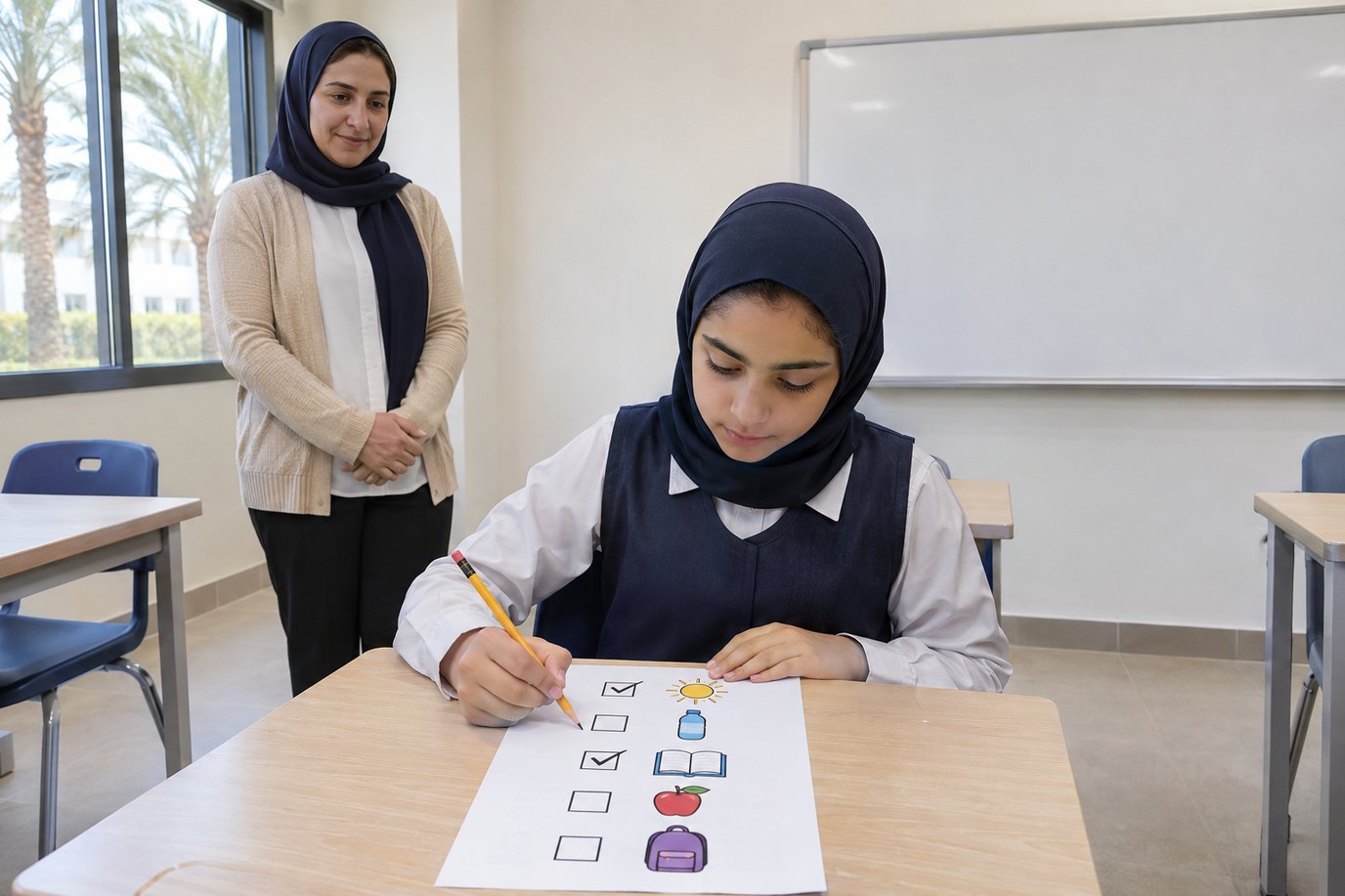
Level 1 includes errorless teaching and prompting, active student responding, beginner classroom participation skills, and an introduction to understanding behaviour through a functional behaviour assessment.
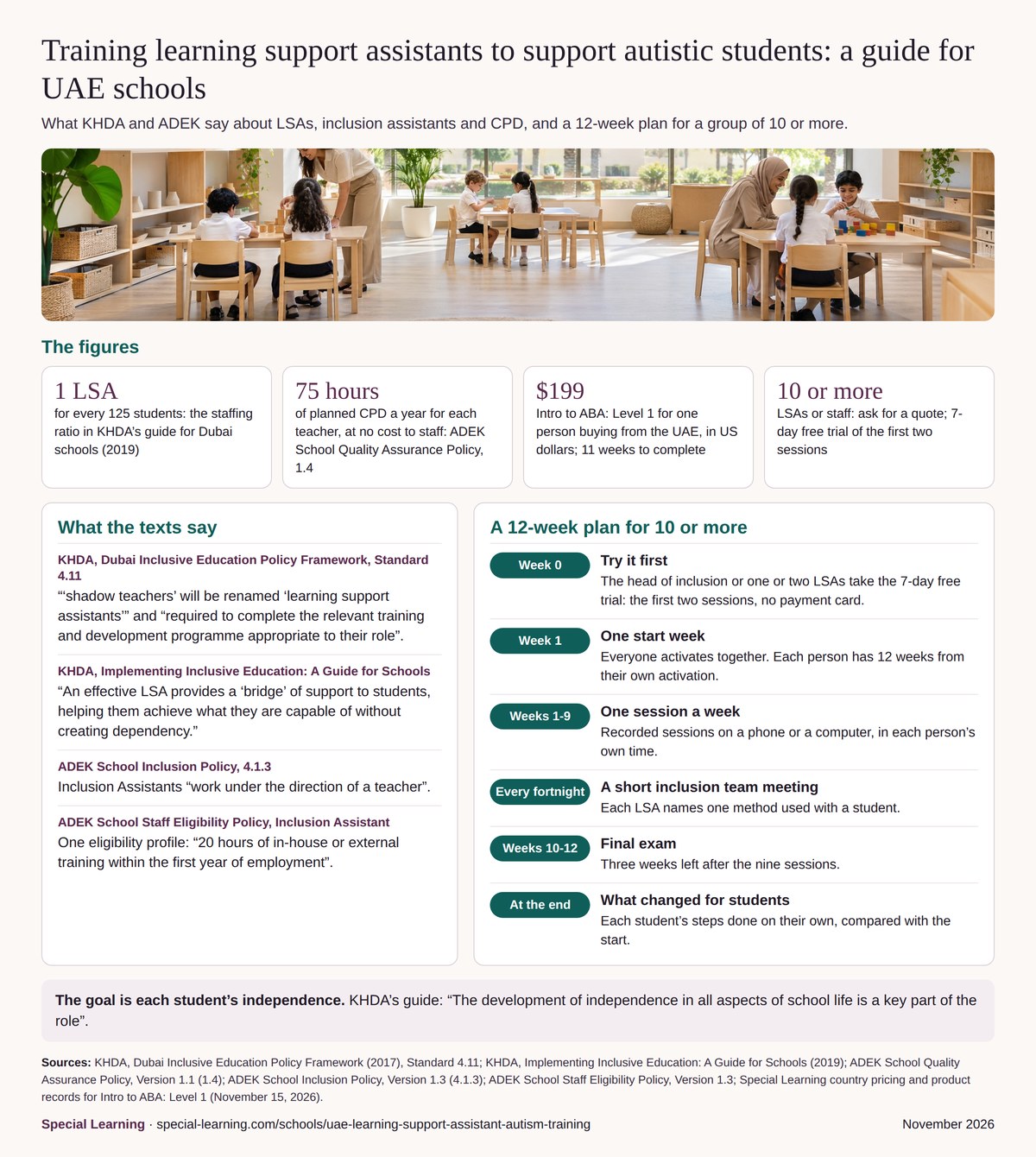
A 12-week plan for a group of 10 or more. Week 0: the head of inclusion or one or two LSAs take the free trial. Week 1: everyone activates in the same week; each person has 12 weeks from their own activation. Weeks 1 to 9: one session a week, in each person’s own time. Every fortnight: a short inclusion team meeting where each LSA names one method they used with a student. Weeks 10 to 12: the final exam. Then compare each student’s record of steps done on their own with the start.
When the school pays
06How a school buys
Each school and school group has its own purchase process, and your finance office knows the route that applies. Here is how it works with us.

- Try it first. The head of inclusion, or one or two LSAs, take the 7-day free trial: the first two sessions, with no payment card (start the trial).
- Ask for a quote. Tell us your school, how many staff and that you are in the United Arab Emirates; the form lists it as a country. In the notes, say what your finance office needs, such as a quote on letterhead or a supplier form, and we reply with what we can provide.
- Pay. We send the school an invoice from Special Learning, Inc. in US dollars, paid by bank wire. Or pay by card in our store. Access opens once payment clears.
Planning in more detail? Plan your team.
From the course records, November 15, 2026
07Options and prices
Intro to ABA: Level 1 is a course on the methods and techniques of ABA, built for the people who work with the child every day: parents and caregivers, teachers, paraprofessionals and behaviour technicians. Its nine online sessions run from what autism is to prompting, classroom participation and understanding behaviour (topics covered). A final exam follows, and each session has a short pre-test and post-test.
- One person buying from the UAE: $199, paid once, with 11 weeks to complete the course. The UAE has no separate country price, so the store charges the price our country pricing page lists for the US and other countries, in US dollars (country pricing).
- A school training 10 or more: ask us for a quote, with 12 weeks from the day each person activates. How a school buys.
- The 7-day free trial: the first two sessions, with no payment card (start the trial).
Completing this course earns a Special Learning certificate of completion.
Buy Level 1 for one personQuestions
08Questions heads of inclusion and SENCOs ask
Is a learning support assistant the same as a shadow teacher?
In Dubai, KHDA’s guide says “the LSA replaces the former ‘shadow teacher’”. In Abu Dhabi, ADEK calls parent-funded 1:1 staff individual assistants, “Formerly known as ‘Shadow Teachers’”, and school-appointed staff who support teachers inclusion assistants. US schools say paraprofessional. The roles and responsibilities differ; people in each of them can take Level 1 (shadow teacher training).
How much does Level 1 cost for a person in the UAE?
A person buying from the UAE pays $199, paid once, in US dollars. The UAE has no separate country price, so the store charges the price our country pricing page lists for the US and other countries (country pricing).
We want to train 10 or more LSAs and staff. What does it cost?
Ask us for a quote through the quote form: tell us your school, how many people and that you are in the United Arab Emirates, and we reply with a quote.
How do we pay, and can we get the paperwork our finance office needs?
We send the school an invoice from Special Learning, Inc. in US dollars, paid by bank wire. Or pay by card in our store. Access opens once payment clears. In the notes of the quote form, tell us what your finance office needs and we reply with what we can provide.
Can we try the course before we buy for the team?
Yes. The 7-day free trial covers the first two sessions, and starting it asks for your email, a password and your role, with no payment card (start the trial).
What do LSAs learn in Level 1?
Nine online sessions: what autism is and an overview of ABA, methods of teaching, errorless teaching and prompting, active student responding, teaching methods in application, beginner classroom participation skills, and a first session on decreasing problem behaviour with a functional behaviour assessment. The examples are drawn largely from work with young children in classrooms and homes. A final exam follows, and each session has a short pre-test and post-test.
How long does each person have?
One person buying alone has 11 weeks to complete the course. When a school buys for 10 or more, each person has 12 weeks from the day they activate their own access, so staff who join later start their 12 weeks when they begin.
Do staff receive a certificate?
Completing this course earns a Special Learning certificate of completion.
Can our inclusion teachers and class teachers take it too?
Yes. Level 1 is built for teachers as well as support staff, so the class teacher, the inclusion teacher and the LSA who support the same student can learn the same methods.
Can a family that employs an LSA or individual assistant buy it for them?
Yes. A parent can buy Level 1 for one person in our store, and the LSA can start with the free trial (start the trial). In Dubai, KHDA’s Framework asks schools to agree a memorandum of understanding with parent-employed LSAs that covers “professional induction, monitoring and training requirements” (Dubai Inclusive Education Policy Framework, Standard 4.12).
What does KHDA say about training LSAs?
The Framework’s Standard 4.11 says LSAs “will be required to complete the relevant training and development programme appropriate to their role within a time bound period”, and KHDA’s guide says “LSAs should have access to ongoing professional development to ensure that they are fully effective in their roles” (Dubai Inclusive Education Policy Framework; Implementing Inclusive Education: A Guide for Schools).
Your next step
Watch the first two sessions of Level 1 free for 7 days, then decide with your inclusion team. Starting it asks for no payment card.
Try the first two sessions freeMore for schools: training for schools, training for shadow teachers, autism training for paraprofessionals, training for international schools, teaching assistant training for UK schools, shadow teacher and special educator training for Indian schools, shadow teacher and SPED training for Philippine schools and teacher aide training for Australian schools. For ABA practitioners and certification in the UAE: our UAE guide.